How to build wealth through rental properties in 2026


The 2026 map for rental property investors
Rental property investment has built more first-generation wealth than almost any other asset class. The reason is that a rental does three jobs at the same time. It pays you every month through rent. It grows in value while you hold it. And the tenant pays down the mortgage for you. One property is a good move — four or five is how investors build real wealth, because each property does all three of those jobs at the same time, on its own balance sheet.
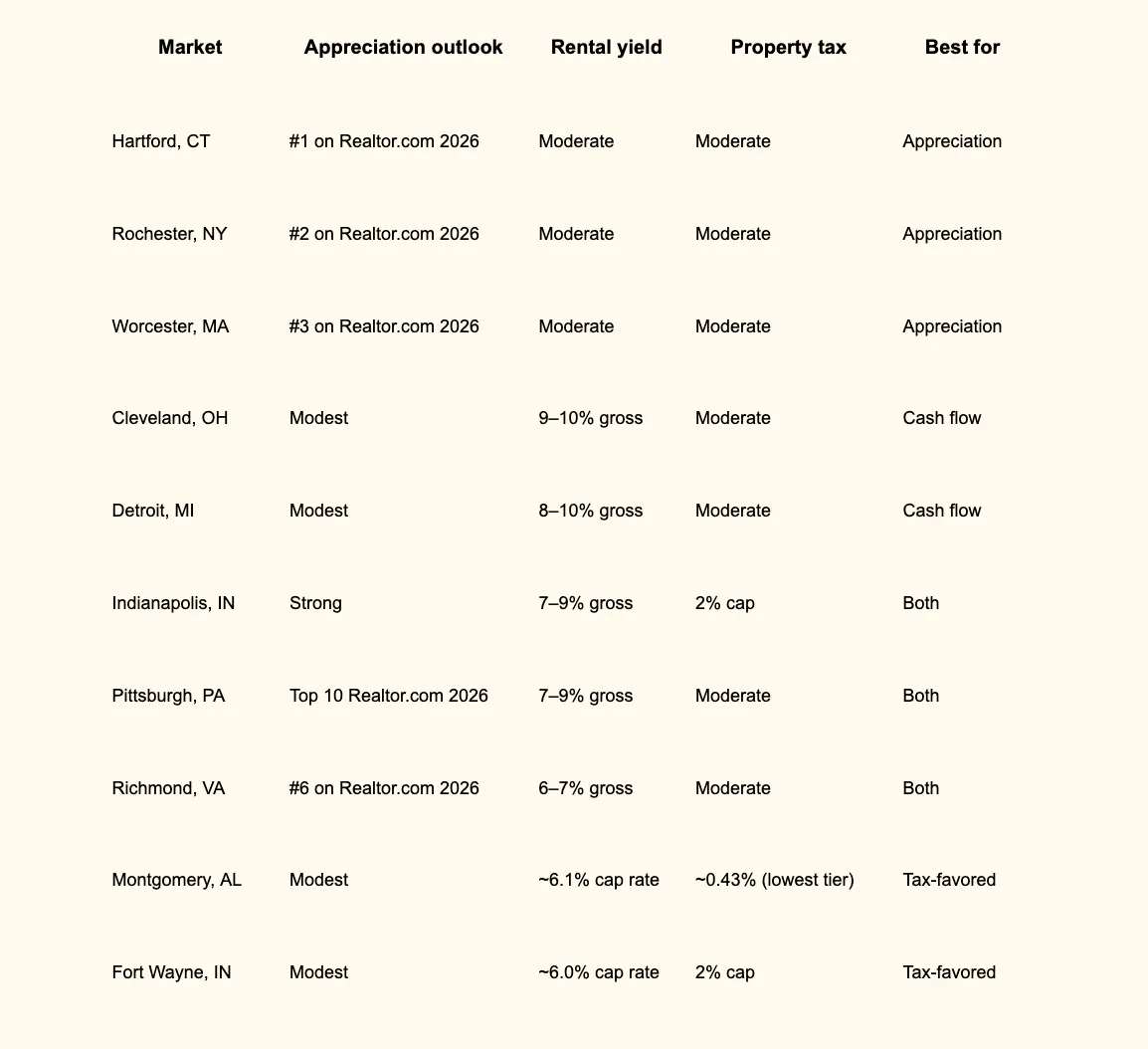
Three recent reports together point to where those numbers are working in 2026. Realtor.com's latest forecast has Hartford, Rochester, and Worcester at the top for projected price growth. ATTOM's most recent yield data has Cleveland, Detroit, and Indianapolis at the top for cash flow. Mashvisor's 2026 ranking of landlord-friendly states has Alabama, Indiana, and Arizona out front on the carrying-cost side. The chart below pulls those three data sets together.
Why own a rental property
Three things happen at the same time when an investor owns a rental, and only one of them shows up on a bank statement.
The first is cash flow. Rent minus mortgage, taxes, insurance, and maintenance is the monthly check the property writes. According to ATTOM's most recent single-family rental yield analysis, the average annual gross yield for three-bedroom rentals across the 361 counties tracked is 7.45%, which translates to meaningful cash flow on a property bought at the right price.
The second is appreciation. The top ten metros in Realtor.com's 2026 forecast have appreciated an average of 16.3% since 2022, while the rest of the country has been essentially flat. Even at the slower national pace, Realtor.com projects about 2.2% appreciation in 2026 nationwide. This means that a property held for ten years grows into a vastly different asset than the one originally bought.
The third, and most overlooked, is amortization. Every month that a tenant pays the rent, a portion of the mortgage principal is paid down. The owner builds equity without writing a check. Over a 30-year mortgage, the tenant effectively buys the property for the owner. On a $250,000 property with 20% down, that is roughly $200,000 in equity built over time by someone else's monthly payment.
Multiply those three engines across four or five properties, and the math works in a way single-property investors rarely see. That is the structural reason rental property has produced the wealth it has — the job is to find the markets where all three engines run at the same time.
Where to own right now
Appreciation has moved north
Realtor.com's Top Housing Markets for 2026 ranks the hundred largest metros by projected combined growth in sales and prices for the year ahead. The top ten is dominated by the Northeast and Midwest: Hartford, Rochester, Worcester, Toledo, Providence, Richmond, Grand Rapids, Milwaukee, New Haven, and Pittsburgh. Median list price across the ten is $384,000, below the national median of $415,000. Prices in these markets are up 16.3% since 2022 while the rest of the country has been flat. Roughly 40% of listing views in Q3 2025 came from buyers outside the local metro, up from 31% before rates rose, which means the demand is broader than the local economy.
The cleanest pure-appreciation plays: Hartford, Worcester, Providence.
Cash flow has stayed in the Midwest
ATTOM's most recent single-family rental yield analysis projects an average gross yield of 7.45% for three-bedroom properties across the 361 counties it tracks. Variation by county is significant. Cleveland is consistently cited as one of the highest-yielding markets in the country at 9% to 10% gross. Detroit, Pittsburgh, and Indianapolis sit in similar territory. Mid-sized cities (populations 100,000 to 500,000) are running gross yields 2 to 3% higher than larger metros, with vacancy between 4% and 6%.
The strongest cash flow markets: Cleveland, Detroit, Indianapolis, Fort Wayne, Toledo.
Property tax is the line item nobody talks about
Effective property tax rates range from under 0.5% in the lowest states to over 2% in the highest. On a $250,000 property, that is the difference between $1,250 and $5,000 a year, every year. Across five rentals, the gap is real money.
Mashvisor's 2026 ranking shows Alabama as the best for effective property tax rates (around 0.43% median). Indiana caps rental property tax statewide at 2%, which is the structural reason Fort Wayne and Indianapolis show up on so many investor lists. Arizona has banned city-level rental taxes. Texas pairs no state income tax with some of the highest property taxes in the country. Florida pairs no state income tax with rising insurance costs that have become a meaningful operating expense.
The cleanest tax math: Alabama, Indiana, Arizona.
Where the three lists meet
The most interesting markets in 2026 are the ones that show up on more than one list. Indianapolis has strong Midwest yields, a property tax cap, and population growth. Pittsburgh is in the Realtor.com top ten and produces strong yields in the right neighborhoods. Richmond is the only Southern metro in the appreciation top ten with newer housing stock and yields that hold up. As Daryl Fairweather, chief economist at Redfin, told Mashvisor, investor purchases in Milwaukee rose 24% in Q4 2025 even after the city tightened tenant protections, because the underlying economics still work.
For an investor balancing appreciation and cash flow, Indianapolis and Pittsburgh are the markets the data points to most clearly in 2026.
How to do it
The strategy is repetition. One property is a transaction. Four or five properties build a portfolio. The wealth math works in the second case, not the first, because each property is paying its own mortgage, generating its own cash flow, and appreciating on its own balance sheet.
The financing piece is where most investors get stuck. Conventional mortgages cap the number of loans an individual can hold, and each one requires more documentation, more reserves, and more proof of personal income than the last. By the third or fourth property, the conventional path closes. The investor with a strong W-2 and three rentals is often the same investor who cannot get approved for the fourth.
DSCR loans are the instrument serious investors use to keep building. The Debt Service Coverage Ratio loan qualifies the property on its own rental income rather than the investor's personal financials. The property is the asset, and the property qualifies the loan.
That structure is what turns the markets above into a portfolio. A property in Pittsburgh that rents for $2,400 against a $2,000 mortgage clears a 1.2 DSCR and has a high chance of qualifying. A single-family rental in Indianapolis where the rent and payment line up does the same. Each property stands on its own balance sheet, which is what lets the next one, and the one after that, get bought. No loan caps. No personal income ceiling. The property either qualifies or it doesn’t.
Beeline writes DSCR loans for investors in every market on the maps above. Check your current rate at https://makeabeeline.com/rates/ and apply in under 10 minutes